Military Operation Name Generator
This military operation name generator creates authentic codenames for any scenario — from tabletop wargames to fiction writing. Inspired by real operations like Desert Storm, Overlord, and Neptune Spear, each name follows the proven patterns used by actual military planners. Many operations are staged from garrisons and outposts, so browsing fort names can ground your setting before picking a codename. Filter by theme and era to match your setting.
How Military Operation Names Are Built
Real military codenames follow a strict logic: they must be memorable, unclassified, and give nothing away about the mission's true objective. Operation Overlord referred to the D-Day landings but revealed no tactical detail. Operation Neptune Spear — the raid that killed Osama bin Laden — used mythology, not geography. This deliberate ambiguity is the foundation of every good operation name.
The dominant pattern is "Operation [Strong Noun]": a single evocative word drawn from nature, mythology, or abstract concepts. Desert Storm, Rolling Thunder, and Iron Fist follow this formula. A less common but equally effective structure is "Project [Adjective] [Noun]" — useful when naming a long-running program rather than a single mission. This second format appears frequently in intelligence and stealth contexts, where the operation name generator can suggest options like Project Silent Arrow or Project Iron Veil.
Era matters for tone. WWII codenames favored classical references and bold imagery — Overlord, Barbarossa, Market Garden. Cold War names leaned cryptic and abstract — Mockingbird, Paperclip, MKUltra. Modern operations blend both traditions. Futuristic or sci-fi settings often push toward technical compound words. Matching your codename's register to its era makes it feel grounded, whether you are building a wolf-pack unit, a mercenary-group faction, or a full military campaign for your fiction.
Choosing the Right Operation Name
Start with your mission's primary objective, then work against it. If your operation is a rescue, avoid any word that signals rescue — choose something cold and abstract instead, like Operation Iron Vigil or Operation Pale Horizon. This counterintuitive approach mirrors real military practice and produces names that feel authentic rather than on-the-nose.
Theme filters help narrow the field fast. Stealth operations benefit from names drawn from silence, shadow, or precision — Whisper, Veil, Specter. Assault themes call for force and momentum — Hammer, Surge, Ironclad. Recon names often reference vision or speed — Falcon, Prism, Overwatch. For a project or discord-server set in a military universe, keeping consistent naming conventions across all your operations reinforces worldbuilding coherence. Many missions are executed by contractors, so browsing mercenary group names can help define the forces behind your operations.
Games like COD and Fallout have popularized the operation codename aesthetic well beyond military fiction. If you are building a campaign for a tabletop RPG or writing a thriller novel, consider using the operation name generator to generate a shortlist of ten candidates, then test each one by saying it aloud — the best military codenames are instantly pronounceable and stick in memory after a single hearing.
Popular Military Operation Names and Their Meanings
| Name | Meaning | Origin | Gender |
|---|---|---|---|
| Operation Obsidian Spear | Precision strike on a high-value target under complete communications blackout | Modern | Neutral |
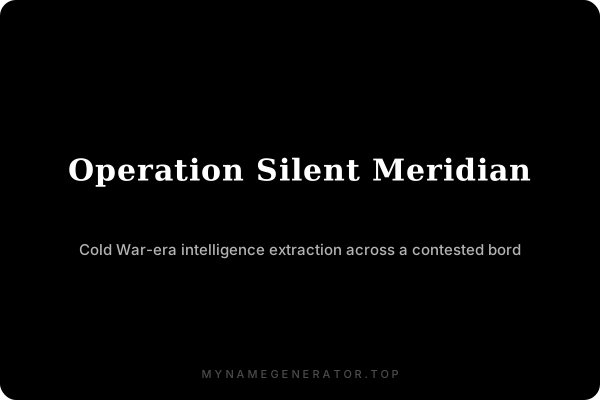
| Operation Silent Meridian | Cold War-era intelligence extraction across a contested border | ColdWar | Neutral |
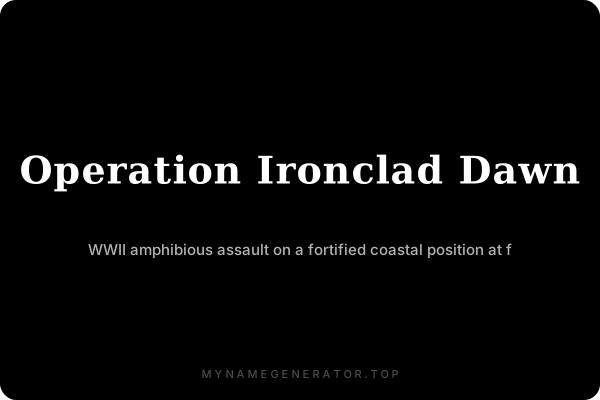
| Operation Ironclad Dawn | WWII amphibious assault on a fortified coastal position at first light | WWII | Neutral |
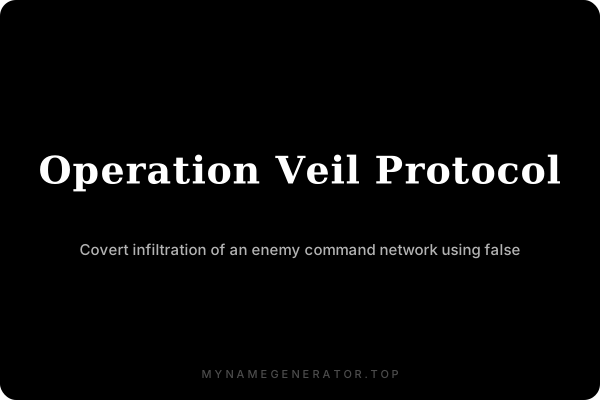
| Operation Veil Protocol | Covert infiltration of an enemy command network using false identities | Modern | Neutral |
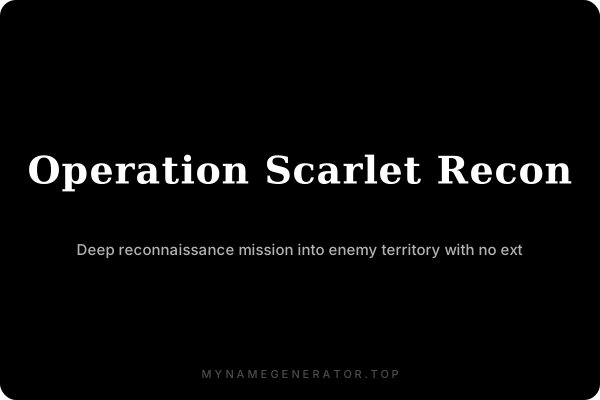
| Operation Scarlet Recon | Deep reconnaissance mission into enemy territory with no extraction support | Modern | Neutral |
| Operation Phantom Liberation | Rescue of political prisoners from a fortified detention facility | ColdWar | Neutral |
| Operation Titanfall | Futuristic orbital drop assault on a planetary defense grid | Futuristic | Neutral |
| Operation Falcon Shroud | Aerial recon and electronic warfare package over denied airspace | Modern | Neutral |
| Operation Ember Watch | WWII resistance network providing intelligence from occupied cities | WWII | Neutral |
| Operation Null Signal | Stealth cyber-warfare operation disabling enemy satellite communications | Futuristic | Neutral |
| Operation Sabre Rescue | Hostage recovery mission in a collapsed-state urban environment | Modern | Neutral |
| Operation Glacier Strike | Cold War tactical assault designed to look like a defensive exercise | ColdWar | Neutral |
Featured Name Cards
Frequently Asked Questions
What is a military operation name generator?
A military operation name generator creates authentic-sounding codenames modeled on real military naming conventions — the same patterns behind Operation Overlord, Desert Storm, and Neptune Spear. It is useful for fiction writers, game masters, and worldbuilders who need plausible mission names without inventing them from scratch.
What makes a good operation name?
The best operation names are short, memorable, and deliberately unrelated to the mission's true objective. Real military planners use this ambiguity to protect classified information. A name like Operation Silent Meridian reveals nothing about the mission while carrying strong thematic weight. Avoiding geographic references and obvious tactical hints is the key rule.
Can I use these names for fiction, games, or role-playing?
Yes, all generated names are free to use for any creative purpose — novels, screenplays, tabletop RPGs, video game campaigns, or worldbuilding projects. The filters let you match the era and theme of your setting precisely, whether you need a WWII resistance mission or a futuristic stealth operation.
What is the difference between an operation name and a project name?
Operation names typically refer to a single discrete mission with a defined start and end. Project names — like Project Paperclip or Project MKUltra — denote longer-running programs, often in intelligence or research contexts. The operation name generator covers both formats, letting you pick the structure that fits your scenario.
How do I choose between the theme filters?
Match the filter to the mission's primary method, not its goal. A rescue accomplished through stealth should use the Stealth filter for naming, not the Rescue filter — real codenames never reveal the mission type. Use Assault for direct kinetic action, Intelligence for information-gathering, Liberation for freeing personnel or territory, Recon for surveillance, and Stealth for any operation that depends on remaining undetected.