Medieval Names Generator
From castle halls to muddy villages, the medieval period produced some of history's most evocative names. Our medieval name generator creates 200+ authentic-sounding names spanning every social class of the Middle Ages — from kings and knights to peasants and pilgrims. Whether you're writing historical fiction, building a D&D campaign set in a feudal world, or naming characters in a video game — fans of dark souls names will recognize the same grim, knightly atmosphere — these medieval names capture the grit, grandeur, and spirit of the era. Like courtesy names that encode status and virtue, medieval names reveal who a person was in their world.
Medieval Naming Conventions
Medieval names followed patterns deeply tied to social hierarchy, religion, and geography. Nobility favored Norman French and Latin-derived names — Eleanor, Geoffrey, Alaric, Isolde — that carried weight and authority. Peasant names were simpler and more grounded: Agnes, Godfrey, Henric, Marion. A person's name often signaled their station before they spoke a word, making medieval names a kind of social shorthand that persisted for centuries.
Surnames in the Middle Ages emerged from four main sources: occupation (Smith, Cooper, Fletcher), location (of Rouen, of Canterbury), parentage (Williamson, FitzGerald), and personal traits (the Bold, the Wanderer). This system produced compound names like "Roland of Rouen" or "Beatrice Stonehelm" — names that told a complete story. Unlike chinese names where family lineage comes first, or japanese names where kanji encode layered meaning, medieval names were descriptive and earned, especially among common folk. Communities like the amish have preserved similar patterns of inherited given names and occupational surnames that trace directly back to medieval Germanic traditions.
Religious influence was pervasive. Saints' names dominated baptismal records — Agnes, Cecily, Benedict, Roland — and monastic names followed separate traditions entirely. A middle ages name generator must account for this diversity: the same era produced both the thunderous "Alaric the Conqueror" and the humble "Agnes the Wanderer," reflecting a world where name and destiny were inseparable.
Choosing the Right Medieval Name
Match the name to your character's social class. A medieval noble name carries the weight of lineage — "Isolde of Rouen" or "Alaric Frostbane" suggest power and breeding. Knights and warlords suit strong, martial-sounding names with Anglo-Saxon or Norman roots. For peasants and farmers, choose simpler constructions — single names or names with occupational surnames that ground the character in daily life.
For D&D and tabletop RPGs, medieval names form the backbone of most fantasy settings. A wizard named "Lorian Frostbane" or a rogue called "Renard the Bold" feels instantly at home in any campaign. Pair a first name with a title or epithet for memorable NPCs: "Geoffrey the Bold, Merchant of the Eastern Road" or "Adelaide Blackwood, Squire to the Iron Duke." These names work because they combine the familiar and the specific.
Historical accuracy adds depth but isn't required. Real medieval records show that names varied enormously by region — an English peasant, a French noble, and a Scandinavian warrior all lived in the "Middle Ages" but bore wildly different names. The nord tradition in particular — Viking and Norse names like Sigrid, Bjorn, or Astrid — represents a distinct medieval branch with its own runic and mythological roots. Similarly, scottish clan names introduced "Mac-" patronymics and Highland surnames that shaped medieval naming across the British Isles. For fantasy world-building, use this variety as inspiration. Create distinct naming traditions for different regions of your world, much like native american names reflect specific tribal traditions or demon names carry their own dark linguistic rules.
Medieval Names Generator by Variant
Medieval Male Names
Medieval male names trace back to a blend of Anglo-Saxon, Norman, and Frankish influences. Strong single-syllable roots (Aelf-, Ed-, Wulf-, Hen-) combine with suffixes meaning ruler (-ric), wolf (-ulf), or noble (-bert) to produce names like Aldric, Edmund, Henric, and Wulfgar. For knights and royal characters, consider pairing a strong first name with a regional surname or a battlefield nickname — "Henric the Wanderer" or "Aldric Stonehelm". These names work especially well for tabletop RPGs, fantasy novels, and historical fiction set between the 9th and 15th centuries.
- Henric the Wanderer A queen whose diplomacy has united feuding houses
- Geoffrey of Canterbury A priest rumored to wield miracles and curses alike
- Tristan Ironhand A peasant who rose to fame after slaying a marauding beast
- Henric of Canterbury An alchemist in search of the elusive elixir of life
- Ulric Stonehelm A feared knight whose swordsmanship is matched only by his honor
- Edric Stonehelm Once a humble farmer, now renowned for wisdom in the king’s court
- Geoffrey the Bold A bard with tales so vivid they are mistaken for prophecy
- Henric of Rouen A bard with tales so vivid they are mistaken for prophecy
- Roland of Rouen Haunted by visions of the plague, yet known as a savior of villages
- Osric the Wanderer Raised among wolves, now a hunter feared in every forest
- Geoffrey the Bold A queen whose diplomacy has united feuding houses
- Edric the Bold A priest rumored to wield miracles and curses alike
Medieval Female Names
Medieval female names favor flowing vowels and ecclesiastical or noble Latin roots: Beatrice (blessed), Constance (steadfast), Isolde (the fair), Matilda (mighty in battle), Eleanor (light). These names dominated court records and church registries for centuries. For storytelling, female medieval names pair naturally with descriptive epithets — "Lady Constance the Fair" or "Dame Elara the Bold" — giving immediate sense of social rank and personality. Whether designing a queen, an abbess, a healer, or a peasant heroine, these names carry instant medieval authenticity without sounding archaic to modern ears.
- Beatrice Stonehelm A bard with tales so vivid they are mistaken for prophecy
- Rowena Ironhand A bard with tales so vivid they are mistaken for prophecy
- Agnes the Wanderer Known to laugh in the face of danger, a mercenary unmatched
- Isolde of Rouen Beloved by villagers, protector of the weak and weary
- Cecily of Rouen A sailor who returned from voyages with tales of lost isles
- Eleanor Blackwood Her songs echo through taverns, inspiring courage and joy
- Hildegard Frostbane Known to laugh in the face of danger, a mercenary unmatched
- Hildegard of York A monk sworn to silence, yet his eyes speak volumes of wisdom
- Matilda Stonehelm Mysterious maiden whose beauty hides a blade’s edge
- Cecily the Wanderer A guard who secretly dreams of becoming a minstrel
- Beatrice the Bold A noble with ambitions that stretch beyond the realm’s borders
- Adelaide the Pious Her songs echo through taverns, inspiring courage and joy
Medieval Surnames
Medieval surnames emerged from four sources: place names (Blackmoor, Ravensworth, of the Marsh), occupations (Stonehelm from a stonemason lineage, Ironbough from blacksmiths), patronymics (son-of constructions), and descriptive epithets that became hereditary (Goldshire for prosperous families, Greycliff for coastal ones). Norman conquest introduced "de" and "von" prefixes for continental nobility (de Caer Lyon, von Wildenburg). When building a medieval character, choose a surname that hints at family origin — a place, a craft, or an ancestor's quirk — and your character gains centuries of implied backstory for free.
- Blackmoor An ancient family surname linked to the marshlands of the eastern borders
- Stonehelm A stonemason lineage whose crest depicts a chiseled helm worn by ancestors
- Ravensworth A noble surname tied to a hill where ravens once nested in great numbers
- Ironbough A blacksmith family famed for the iron-banded oak of their ancestral hall
- Stormholm An island family known for surviving a hurricane that destroyed three rival keep…
- Hollowmere A surname belonging to those who dwell near the misty hollow lakes
- of the Marsh A common surname adopted by peasants and minor knights of fenland origin
- von Wildenburg A Germanic-sounding noble surname from a remote fortified hilltop estate
- de Caer Lyon A continental noble surname tracing back to a citadel by a sacred river
- Ashforde A family surname from a shallow river crossing once burned by raiders
- Blackwood An infamous surname tied to a forest where outlaws and rebels once hid
- Goldshire A prosperous merchant family whose name comes from a wheat-rich valley
Medieval Nicknames
Medieval nicknames — also called epithets or bynames — were earned, never chosen. A knight became "the Bold" only after a battlefield charge that broke a shield-wall. A counselor was called "the Quiet" only after years of swaying courts with few words. Categories include valor epithets (Lionheart, Stormbreaker, Ironheart), wisdom epithets (the Wise, the Just, the Pious), mysterious ones (Blackcloak, the Hooded, the Silent), and grim ones (Skullbreaker, Bloodfen, the Mournful). Use these to deepen a character's history: a single nickname implies a battle, a tragedy, or a transformative moment that shaped them.
- the Bold An honorific earned by warriors who broke shield-walls in legendary charges
- the Wise A reverent epithet for scholars, monks, and elder statesmen of the realm
- the Wanderer A traveler's nickname, often given to knights returning from distant crusades
- Ironheart A nickname for those whose courage never wavered, even in hopeless sieges
- Stormbreaker An epithet given to a warrior who led troops through a cataclysmic naval storm
- the Crimson A blood-soaked battlefield nickname, sometimes feared, sometimes revered
- Oathsworn A nickname for knights who took unbreakable vows before their kings
- the Just An epithet given to judges and lords known for fair rulings even in hard times
- Blackcloak A mysterious nickname tied to a ranger or spy never seen without dark robes
- the Fair A courtly nickname for nobles of striking beauty or famed even temperament
- Skullbreaker A brutal warrior nickname earned in tournament melees and mountain raids
- the Silent An epithet for assassins, monks, and rangers who say little but act decisively
Medieval Titles & Epithets
Medieval titles formed a precise hierarchy: Duke and Duchess at the top of secular nobility, followed by Marquess/Margrave (border lords), Earl/Count, Viscount, and Baron. Within knighthood: Knight Commander led orders, Grand Master ran them. Church titles overlapped — Prince-Bishops held both spiritual and temporal power. Household offices like Seneschal, Chancellor, and Constable carried enormous practical authority. When designing a titled character, attach the title to a name AND a location or function for full impact — "Lord Marshal of the East", "Countess Mabel Ashforde", "Sir Geoffrey Ironbough".
- Sir Aldric Stonehelm A knight banneret in service to the western marches, famed for tournament victor…
- Lord Cedric of Westmoor A landed baron presiding over the prosperous western moor estates
- Lady Constance the Fair A courtly lady famed for her diplomatic skill and her sapphire ring of office
- Baron Reginald Blackmoor A border baron whose fortified manor guards the marshland crossings
- Dame Elara the Bold A knight of the Order of the Silver Stag, decorated for valor in three campaigns…
- Knight Commander Roderic A senior officer of a chivalric order, leading the eastern temple guard
- Duke Aldwin of Highmark A powerful duke whose territory borders three rival kingdoms simultaneously
- Earl Marshal Thomas The hereditary commander of all royal cavalry, master of the king's stables
- Countess Mabel Ashforde A widowed countess managing vast inherited estates with quiet, ruthless skill
- High Steward Eadric The chief administrator of the royal household, second only to the king himself
- Sir Geoffrey Ironbough A loyal knight whose family has served the crown for seven generations unbroken
- Lord Marshal of the East A military title commanding all border garrisons against eastern raids
Medieval Peasant Names
Medieval peasant names were plain, practical, and rooted in daily life. Commoners carried simple given names — Aldous, Hild, Wat, Maud — often paired with a byname drawn from a trade, a place, or a parent rather than a noble house. Unlike the grand titles of lords and ladies, peasant names rarely changed across generations and carried no heraldry. For historical fiction, an RPG village scene, or a grounded fantasy setting, these names give farmers, labourers, and tavern folk an authentic, lived-in feel. Use the Peasant filter to generate humble medieval names for the common folk of your world.
- Lina Fishwife She hawks river eels and trout at the weekly market stall.
- Bertin Herdsman He drives the cattle to summer pasture on the high common.
- Edda Washerwoman She scrubs the manor linens at the cold village stream.
- Adam Digger A ditcher who drains the lord's fields with spade and toil.
- Agnes Gleaner An old widow who gathers the grain left after the reaping.
- Dunstan Fletcher A bowyer's hand who feathers arrows for the lord's levy.
- Tibb Henwife She tends the hens and trades eggs for salt and candles.
- Colle Woodward A forester's man who gathers deadfall for the manor hearths.
- Mabel Thresher She beats the grain from the straw on the threshing floor.
- Leofric Cottar A landless peasant who works another's strips for a daily wage.
- Gytha Reaper A field-hand who binds the sheaves under the harvest sun.
- Osmund Swineherd A herder who fattens the village pigs on autumn acorns.
Medieval Fantasy Names
Medieval fantasy names blend authentic historical roots with the heightened flavor fiction demands. Where straight historical records give you “Geoffrey” or “Agnes,” medieval fantasy names lean into evocative surnames and epithets — Frostbane, Ironhand, Stonehelm — that read as authentic without needing a history degree to pronounce. This style dominates D&D campaigns, epic fantasy novels, and RPGs set in quasi-medieval worlds, where a name has to feel lived-in the moment a player or reader sees it. The best medieval fantasy names still follow real naming logic — a strong first name paired with an occupational, geographic, or heroic surname — they simply push the imagery further into legend.
- Lorian Frostbane A feared knight whose swordsmanship is matched only by his honor
- Agnes Blackwood Mysterious maiden whose beauty hides a blade’s edge
- Tristan of Rouen Once cloaked in poverty, now a merchant of vast fortune
- Quentin Frostbane Warlord of the north, commanding with ruthless discipline
- Beatrice Ironhand Builder of cathedrals, shaping stone into monuments of faith
- Ulric of Rouen A bard with tales so vivid they are mistaken for prophecy
- Elinor Stonehelm A peasant who rose to fame after slaying a marauding beast
- Clovis the Pious A seasoned warrior known for unyielding loyalty on the battlefield
- Quentin Ironhand Guardian of sacred texts, devoted to preserving ancient lore
- Gervaise of Rouen A scholar who uncovered forbidden tomes best left unread
Medieval Clan and Faction Names
Beyond individual names, medieval-inspired worlds need names for the groups people belong to — clans, mercenary companies, armies, and rival factions. Clan names often carry a shared surname or totem (Clan Ashveil, Clan Direfrost), while faction and army names lean on rank, purpose, or a rallying symbol (the Crimson Vanguard, the Ironwolf Legion). These group names matter as much as individual names for world-building: a warband called the Stormrend Company tells a very different story than a noble house called the Emberfall Line. Use them to label rival kingdoms’ armies, mercenary guilds, secret orders, or the extended family a character belongs to in a D&D campaign or historical-fantasy story.
- Clan Ashveil A highland clan bound by a shared oath to guard the northern passes
- House Ravensbane A noble house whose banner bears a slain raven for a fallen enemy
- The Ironwolf Legion A mercenary company known for iron discipline and wolf-pelt cloaks
- Clan Direfrost A clan from the frozen marches, feared for their winter raids
- The Crimson Vanguard An elite faction that always marches at the front of the king's army
- House Emberfall A once-great line brought low by fire and betrayal, now rebuilding
- The Wolfsbane Company A band of sellswords who take contracts no lord's army will touch
- Clan Stormrend A coastal clan whose warriors are said to sail into any storm
- The Silver Talon Order A knightly faction sworn to hunt down oathbreakers and traitors
- House Grimwarden A minor house entrusted with guarding the realm's border keeps
Medieval Noble Names
Medieval noble names carry the weight of lineage — names built to be spoken in a great hall, not a village square. Where peasant names stayed simple and practical, noble names favored Norman French and Latin-derived roots, often paired with a surname evoking land, ancestry, or a memorable deed: Osric Blackwood, Eleanor of Rouen, Roland of York. These names signaled status before a character spoke a word, and they still work that way in fiction and tabletop gaming today. Use the Noble filter to generate names fit for lords, ladies, courtiers, and dynastic families — the counterpart to the humbler Peasant names elsewhere on this page, and the natural choice for any character born into privilege.
- Gervaise Frostbane Known to laugh in the face of danger, a mercenary unmatched
- Eleanor of Rouen Her songs echo through taverns, inspiring courage and joy
- Roland the Pious Known to laugh in the face of danger, a mercenary unmatched
- Osric Blackwood Mysterious maiden whose beauty hides a blade’s edge
- Roland of York Warlord of the north, commanding with ruthless discipline
- Aldwyn of Rouen A monk sworn to silence, yet his eyes speak volumes of wisdom
- Lorian Stonehelm A bard with tales so vivid they are mistaken for prophecy
- Ansel the Bold Squire to a fallen knight, now seeking to forge his own legacy
- Whitehall A noble lineage seated in a chalk-white keep visible from the coastal road
- Thornfield A border-marshal surname earned defending fields ringed by thorn-hedges
- Caverleigh An ancient Cornish-style surname tied to a network of coastal caves
- Blackmoor An ancient family surname linked to the marshlands of the eastern borders.
- Stonehelm A stonemason lineage whose crest depicts a chiseled helm worn by ancestors.
Popular Medieval Names and Their Meanings
| Name | Meaning | Origin | Gender |
|---|---|---|---|
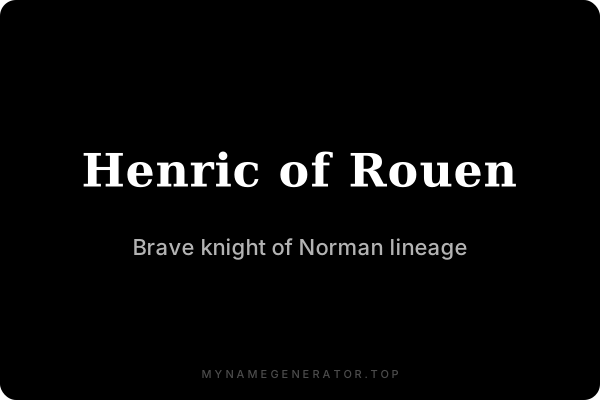
| Henric of Rouen | Brave knight of Norman lineage | Norman French | Male |
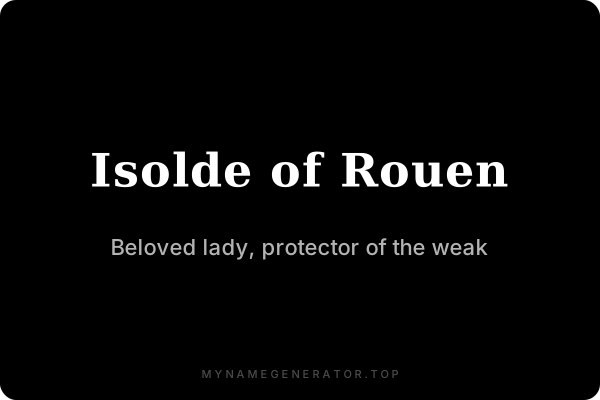
| Isolde of Rouen | Beloved lady, protector of the weak | Celtic | Female |
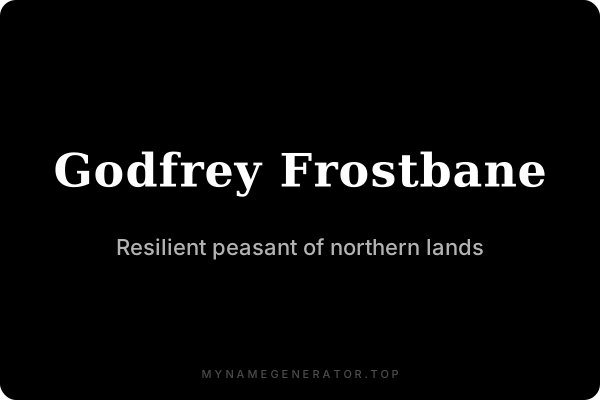
| Godfrey Frostbane | Resilient peasant of northern lands | Germanic | Male |
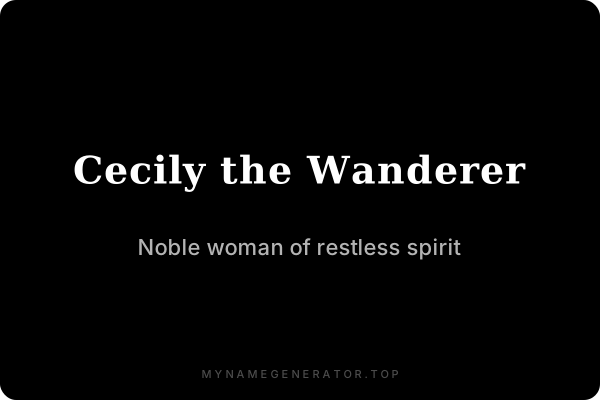
| Cecily the Wanderer | Noble woman of restless spirit | Latin | Female |
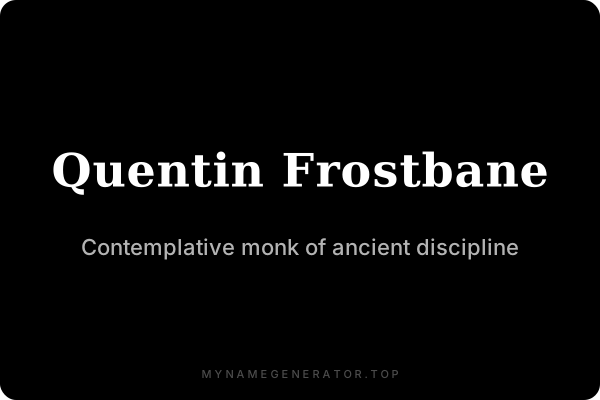
| Quentin Frostbane | Contemplative monk of ancient discipline | Latin | Neutral |
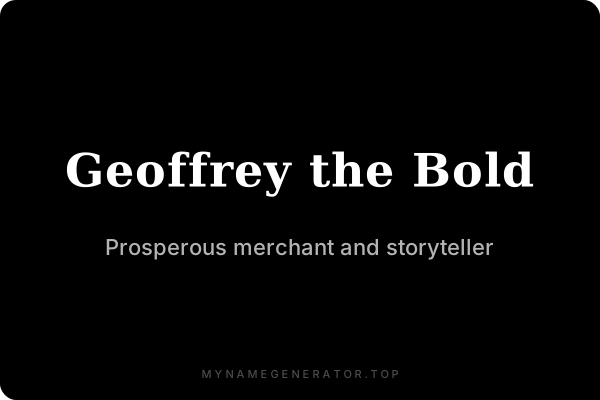
| Geoffrey the Bold | Prosperous merchant and storyteller | Norman French | Male |
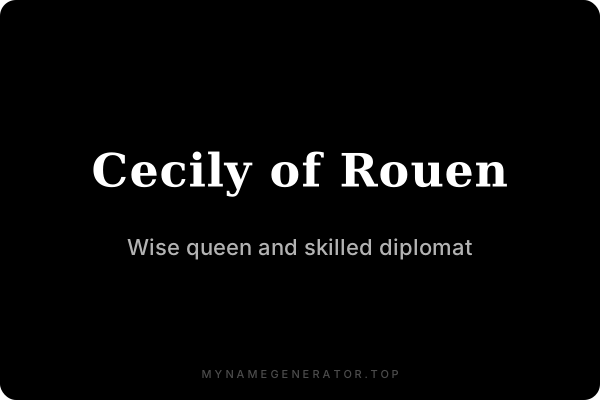
| Cecily of Rouen | Wise queen and skilled diplomat | Latin | Female |
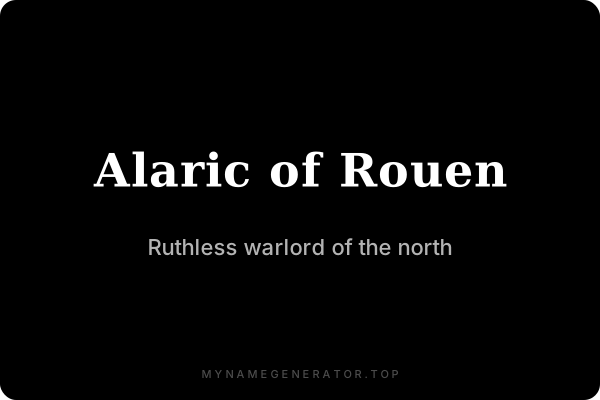
| Alaric of Rouen | Ruthless warlord of the north | Germanic | Male |
| Beatrice of Rouen | Gifted healer whose songs inspire courage | Latin | Female |
| Marion of Canterbury | Wandering bard and seeker of truth | Old French | Neutral |
| Roland of Rouen | Devout pilgrim on a path of redemption | Germanic | Male |
| Adelaide Blackwood | Determined squire rising through the ranks | Germanic | Female |
Featured Name Cards
Frequently Asked Questions
What are medieval names?
Medieval names are names from the European Middle Ages (roughly 5th to 15th century), drawn from Latin, Germanic, Celtic, and Norman French roots. They often reflect social class, religion, occupation, or place of origin — from royal names like Isolde and Alaric to common names like Agnes and Henric.
What is a good medieval noble name?
Strong medieval noble names combine a distinguished first name with a location or epithet — Isolde of Rouen, Alaric Frostbane, Adelaide Blackwood. Norman French and Germanic roots sound particularly aristocratic. For added gravitas, pair with a title: Lord, Lady, or a descriptive epithet like 'the Bold.'
Can I use these middle ages names for D&D?
Absolutely! Medieval names are the foundation of most D&D settings. They work for knights, nobles, merchants, peasants, and clergy alike. Filter by social class to find names that match your character's background — a squire sounds different from a warlord.
What's the difference between medieval names and fantasy names?
Medieval names are rooted in real historical linguistics — Latin, Old English, Norman French, Germanic. Fantasy names borrow these roots but add invented elements. A medieval name like 'Geoffrey of Canterbury' is historically plausible; a fantasy name like 'Lorian Frostbane' takes medieval patterns and pushes them into the imaginary.
How were medieval peasant names different from noble names?
Peasant names were simpler and more practical — often a single given name plus an occupational or descriptive surname (Agnes the Wanderer, Godfrey Smith). Noble names were grander, incorporating location markers (of Rouen, of Canterbury) or prestigious family names, reflecting lineage and political alliances.