Utopia Name Generator
From gleaming futuristic cities to serene pastoral havens, utopia names shape the identity of your perfect society. Whether you're writing speculative fiction, building a tabletop world, or designing a game, these utopia names blend classical roots with imaginative vision to bring your ideal civilization to life.
How Utopia Names Are Constructed
Utopia names draw deeply from Latin and Greek roots that evoke light, harmony, and abundance. Words like lumen (light), sol (sun), elysium (paradise), and verdant (lush greenery) form the building blocks of names that feel both noble and aspirational. A city built on these roots immediately signals a world of order, beauty, and hope.
Compound structures are another common pattern — two evocative words fused into one. "Sky" paired with "haven" produces Skyhaven, a name that reads as both a place and a promise. Similarly, "Halcyon" (serene) joined with "Deep" anchors an underground sanctuary in the imagination instantly.
Classical prefixes like Neo- (new) and Aetheria- (of the upper air) lend a sense of civilization reborn or elevated. Spiritual suffixes such as -anum, -is, and -ia give names a ceremonial weight — fitting for societies built around shared values, ritual, or transcendence. Combining these patterns produces names that feel distinctly utopian: timeless yet invented, familiar yet wholly new.
Inspirations for Your Utopian World
The literary tradition of utopian naming stretches back centuries. Thomas More coined "Utopia" itself from Greek roots meaning "no place," and Plato's Atlantis established the archetype of a brilliant civilization lost to hubris. Ursula K. Le Guin's Anarres in The Dispossessed and Iain M. Banks' Culture worlds showed how a name can carry an entire philosophy — anarchist, post-scarcity, radically free.
Modern fiction has expanded the palette further. Star Trek's Federation evokes cooperation through clean, multi-syllabic naming. Wakanda blends African linguistic roots with futuristic ambition. Themyscira, the island home of Wonder Woman, uses classical Greek structure to signal a society apart from the corrupted world. Each of these fictional places earns its name through a distinct cultural identity.
Real-world intentional communities and eco-villages offer grounded inspiration too. Auroville in India, Findhorn in Scotland, and countless permaculture settlements choose names that reflect their founding ideals — light, earth, renewal. Whether your utopia is a gleaming city in the sky, a hidden cave civilization, a coral island sanctuary, or an elven-city woven into ancient forest, its name is the first clue to what it believes in.
Popular Utopia Names and Their Meanings
| Name | Meaning | Origin | Gender |
|---|---|---|---|
| Elysium | Paradise of the blessed; realm of perfect peace | Greek | Neutral |
| Solaris Prime | First city of the sun; seat of solar civilization | Latin | Neutral |
| Verdantia | Land of endless green; nature's perfect order | Latin | Neutral |
| Coralis | City of living coral; harmony beneath the waves | Latin/Greek | Neutral |
| Skyhaven | Refuge above the clouds; sanctuary of open air | English compound | Neutral |
| Halcyon Deep | Serene underground realm; peace carved from stone | Greek/English | Neutral |
| Sanctum Lumen | Sacred place of light; spiritual heart of the world | Latin | Neutral |
| New Eden | Reborn paradise; humanity's second chance at harmony | Hebrew/English | Neutral |
| Harmonia | City of accord; where all factions dwell as one | Greek | Neutral |
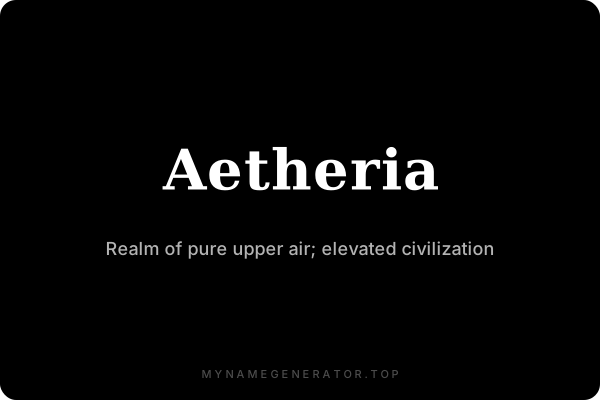
| Aetheria | Realm of pure upper air; elevated civilization | Greek | Neutral |
| Lumen Vale | Valley flooded with perpetual light; luminous refuge | Latin/English | Neutral |
| Arcadia | Pastoral paradise; simple perfection amid wild nature | Greek | Neutral |
Featured Name Cards
Frequently Asked Questions
What makes a good utopia name?
The best utopia names combine an evocative meaning with a sound that feels both timeless and intentional. Drawing from Latin or Greek roots — words like lumen (light), sol (sun), or verdant (green) — gives a name instant gravitas. Compound names like Skyhaven or Halcyon Deep work well too, fusing two ideas into a single image. The name should hint at the society's core values: peace, abundance, light, or harmony.
What are some famous fictional utopian city names?
Classic examples include Elysium (Greek mythology), Atlantis (Plato), and Arcadia (pastoral poetry). Modern fiction adds Wakanda (Black Panther), Themyscira (Wonder Woman), and the various Culture worlds from Iain M. Banks. In games, cities like Rapture from BioShock or Midgar from Final Fantasy explore utopian ideals turned dark — a reminder that a utopia's name often outlasts the dream it represents.
Can I use these utopia names for D&D or tabletop RPGs?
Absolutely. Names like Sanctum Lumen, Aetheria, or Coralis work perfectly as D&D city names, functioning as a hidden monastery, an airborne elven-city, or an underwater civilization. For an underground campaign, Halcyon Deep could serve as a dwarven utopia carved beneath a mountain. Pair any of these names with a defining trait — a castle at its heart, an island location, or a cave network below — to anchor it in your world.
How do I name a futuristic utopian city for science fiction?
For sci-fi settings, lean into Latin or Greek scientific roots combined with structural modifiers. Solaris Prime, Aetheria Station, or Neo-Lumen all suggest advanced civilizations without sounding purely fantastical. Adding a cardinal direction, a number, or a descriptor like 'Prime' or 'Core' reinforces the sense of a planned, rationally organized society — a hallmark of futuristic utopian city names in the tradition of Star Trek's Federation worlds.
What is the difference between a utopia and a dystopia name?
Utopia names tend toward open vowels, soft consonants, and meanings rooted in light, harmony, and nature — Harmonia, Verdantia, Elysium. Dystopia names often twist these same roots into something harder or more ironic: Paradiso becomes Paradox, Lumen becomes Lumencorp. The contrast is useful in worldbuilding: a society that calls itself Arcadia while hiding dark secrets uses its utopian name as propaganda, which can be a powerful storytelling device.