Fairy Names Generator
Fairies — the shimmering, mischievous, and sometimes terrifying beings of folklore — have enchanted storytellers for centuries. From Shakespeare's Titania to modern fae courts in urban fantasy, fairy names carry an otherworldly beauty that sets them apart. Like the mermaid, fairies belong to a rich tradition of elemental spirit beings whose names evoke the untamed natural world. Our fairy name generator creates names that sparkle with fae magic, whether you need a gentle pixie for a children's story or a cunning Unseelie lord for your dark fantasy epic.
Fairy Naming Conventions
Traditional fairy names from Celtic and English folklore often derive from nature: flowers (Bluebell, Primrose), natural phenomena (Dewdrop, Moonbeam), and tiny creatures (Cricket, Wren). In Greek mythology, nymph spirits of water, forest, and flower inspired many of these same nature-rooted naming patterns. These names paint pictures of the natural world in miniature, reflecting the fairy's deep connection to the wild.
In contrast, the noble fae of Irish mythology bear names with Gaelic roots — Aine (radiance), Niamh (brightness), Finvarra (fair-haired). These names feel ancient and regal, suitable for the high courts of Faerie. The leprechaun, another iconic figure of Celtic fey-and-spirits lore, shares this same linguistic heritage of short, punchy Gaelic sounds. Far to the east, the ifrit — Arabic fire jinn — shows how other cultures built their own rich traditions of spirit-beings entirely apart from the European fae. The sylph, Paracelsus's elemental air spirit, shares fairy names' airy phonetics — soft sibilants, open vowels — yet belongs to an entirely different tradition. Modern fantasy has blended both traditions, creating names like Elowynn, Thessaly, and Feyrith that feel authentically fae.
Unlike wizard names built on authority or demon names designed to intimidate, fairy names have a musical, lilting quality. They favor soft consonants (l, n, th, v), open vowels, and endings that trail off like wind chimes (-elle, -wyn, -ia, -iel). Even dark fae and Unseelie names maintain this musicality while adding sharper edges — Thornweald, Nighthollow, Briarvex.
Creating Memorable Fairy Names
Start with your fairy's court allegiance. Seelie (light court) fairies tend toward bright, warm names drawn from sunlight, flowers, and spring — Aureliis, Dawnpetal, Solanthiel. Unseelie (dark court) fairies favor twilight, thorns, and winter — Duskmantle, Briarshade, Frosthollow. Wild fae, belonging to neither court, often bear the most unpredictable names.
For high elf or dark elf characters in your world, fairy names can serve as inspiration for related but distinct naming systems. Many fantasy settings treat elves and fae as distant cousins, sharing linguistic roots but diverging over millennia.
In urban fantasy and modern settings, fairies often go by shortened or anglicized versions of their true names — a fairy named Thistledown might introduce herself as "Thistle" to mortals. This dual-naming convention adds depth and can serve as a plot device when a character's true name holds power over them.
Popular Fairy Names and Their Meanings
| Name | Meaning | Origin | Gender |
|---|---|---|---|
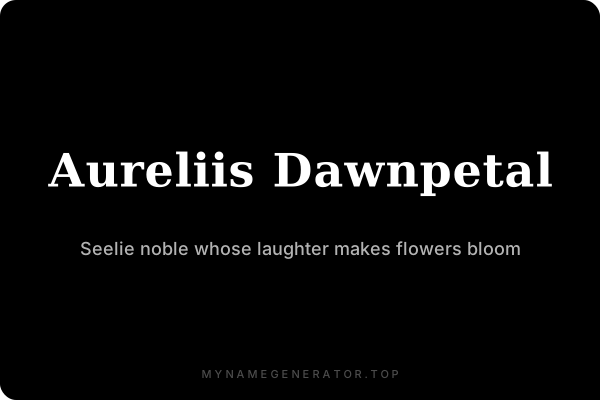
| Aureliis Dawnpetal | Seelie noble whose laughter makes flowers bloom | Fae/Seelie Court | Female |
| Thornweald the Bitter | Unseelie knight sworn to the Winter Queen | Fae/Unseelie Court | Male |
| Willowmere | Wild fae visible only in still water at twilight | Fae/Wild Court | Neutral |
| Solanthiel | Keeper of the Summer Gate | Fae/Seelie Court | Female |
| Briarvex | Thorned fae assassin moving through hedgerows | Fae/Unseelie Court | Male |
| Duskmantle | Unseelie spymaster who wears twilight like a cloak | Fae/Unseelie Court | Male |
| Moonveil | Seelie oracle who reads the future in moonbeams | Fae/Seelie Court | Female |
| Nighthollow | Void fae where light ceases to exist | Fae/Unseelie Court | Neutral |
| Thistledown Lightstep | The fastest fairy alive, races the wind | Fae/Wild Court | Female |
| Grimthistle | Unseelie trickster with dangerous pranks | Fae/Unseelie Court | Male |
| Rivensong | Broken-hearted Seelie bard whose music moves stones | Fae/Seelie Court | Male |
| Ashenbark | Wild fae born from a forest fire | Fae/Wild Court | Neutral |
Featured Name Cards
Frequently Asked Questions
What are fairy names?
Fairy names are names associated with fae creatures in mythology and fantasy. They range from traditional folklore names (Titania, Oberon, Puck) to nature-inspired names (Bluebell, Thornwick) and modern fantasy creations designed for novels, games, and RPG campaigns.
What's the difference between Seelie and Unseelie fairies?
In Scottish and Irish folklore, the Seelie Court represents benevolent (though still tricky) fae, while the Unseelie Court consists of malevolent fairy beings. Modern fantasy has expanded this into a full light court/dark court system, each with distinct naming conventions.
Can fairy names be used for elves?
Absolutely! Many fantasy worlds treat fairies and elves as related species. Fairy names work beautifully for high elves, wood elves, and other fae-adjacent races. The naming patterns overlap significantly, especially for nature-themed characters.
Are fairies always small?
Not in original folklore! The 'tiny fairy' is largely a Victorian invention. In Irish and Scottish mythology, the Sidhe (fae folk) were human-sized or larger, powerful, and often dangerous. Our generator includes names suitable for all fairy traditions.
What fairy names work for dark fantasy?
For darker settings, try Unseelie-inspired names: Thornweald, Nighthollow, Briarvex, Duskmantle, or Grimthistle. These maintain the musical quality of fairy names while adding an edge of danger and mystery suitable for grimdark or horror settings.