Half Orc Name Generator
Half orc names carry a tension no other fantasy lineage shares: the name given at birth against the name chosen to belong. A half orc raised inside an orc tribe inherits guttural birth-names passed down through blood; one raised among humans is often given, or takes, an adopted name to fit in, only reclaiming an orcish root later as an adult. This half orc name generator is built around that split identity: filter by type to pull birth-orc names, human-adopted forms, or the hybrid names carried by characters who never fully choose a side.
Half Orc Naming Conventions: Birth Name vs. Adopted Name
The orcish half of a half orc's identity survives in hard consonants — K, G, Gh, R — and short, punched vowels: Grukk, Thrak, Vorka, Ograk. These are the names given inside the tribe, before any contact with human settlements, and they carry the same blunt weight as a full orc name. A party built around contrasting registers might pair a half orc's guttural birth-name with something airier, like aarakocra names for a scout who circles above the same battlefield.
The human half of the identity shows up as an adopted name — taken, not inherited, usually to survive or belong in a border settlement. The "Personal of Place" pattern captures this directly: Brakk of Westmarch, Pharga of Ironspire, Urgash of Redwater. Unlike a birth-clan name, a place-name is a choice — it tells other characters which community a half orc has decided to claim, human or otherwise, regardless of blood.
A third option skips the choice entirely: an earned epithet built from deed rather than birth or belonging. Boneshatter, Stormfist, Wildbrand — names forged in battle rather than assigned by either parent's people. Some half orcs favor an epithet specifically because it sidesteps the birth-name-versus-adopted-name question; the name answers to nobody's expectations but the character's own reputation, which is why it's a common choice for exiles and wanderers who have left both worlds behind.
Choosing a Heritage: Half Orc Identity in D&D and Pathfinder
Fifth edition frames half orcs around a choice the character has to make, consciously or not: lean into the orc side (savage strength, tribal loyalty) or the human side (adaptability, ambition), or refuse the binary altogether. The best half orc names signal which way a character has leaned — a name that reads as pure threat suggests someone who has embraced the orc half; a softened, human-inflected name suggests someone who has assimilated; a hybrid name suggests someone still deciding.
Eberron pushes this further with the half-orc diplomats of frontier cities, characters whose entire role depends on being legible to both peoples at once — brokering trade, translating oaths, standing as proof the two lineages can share a table. For a party built the same way, half orc diplomat names pair naturally with vedalken names, another lineage built around bridging two worlds through careful, deliberate speech.
Pathfinder's half orcs lean into the same duality but give it geography: raised inside orc warbands, raised in human border towns, or raised nowhere at all as an exile who trusts neither camp. That third path — the exile — produces some of the most distinct half orc names, stripped of both clan markers and adopted surnames, built instead from what the character survived. Whichever path fits your character, filtering by type below narrows the list to names that match the identity they've chosen.
Half Orc Name Generator by Variant
Half-Orc Diplomat Names
Half-orc diplomat names belong to characters who chose the human world without abandoning the orc one — ambassadors, translators, and treaty-brokers stationed in border cities where both bloodlines have to share a table. These names still carry orcish weight in the root (Brekk-, Vren-, Ograk-) but soften at the edges with a title, a place-name, or a trade: Brakk of Westmarch, Vrenna of Saltmere, Wurkar the Broker. A diplomat's name has to survive being said politely in two languages, which is why so many favor a clean two-syllable root over a harsher epithet.
- Brakk of Westmarch Outcast half-orc who earned knighthood defending frontier villages
- Pharga of Ironspire Ambassador half-orc who brokered peace between warring mountain clans
- Urgash of Redwater Diplomat who negotiated trade rights along the blood-stained river road
- Hrekka of Dawnpass Half-orc diplomat who opened eastern trading routes through careful negotiation
- Gukka Silvermend Diplomat who arranges truces by personally mending both sides' wounded
- Wurkar the Broker Diplomat who brokers mercenary contracts between warring orcish warlords
- Brorkar of Dunwall Diplomat stationed in a human city, respected by cautious nobility
- Vrenna of Saltmere Diplomat who brokered fishery rights between coastal orc and human towns
- Gorkath the Patient Diplomat who waited seventeen days to secure a critical trade agreement
- Drokkar Peacehand Diplomat who learned seventeen languages to negotiate with isolated tribes
Half-Orc Exile Names
Half-orc exile names belong to characters who never resolved the identity split — cast out of the orc tribe for weakness or mixed blood, and never fully accepted into human settlements either. These names shed both the clan-root of a birth name and the place-suffix of an adopted one, built instead from what the character survived: Wildbrand, Ashscour, Tombwarden, Coldtide. An exile's name often reads as a scar rather than a title, which makes it the natural pick for a half orc backstory built on rejection from both sides rather than a clean choice between them.
- Ovak the Wanderer Exile who walks lonely roads seeking forgotten orc shrines
- Grukka Wildbrand Exile marked with shame-brands who seeks redemption through good deeds
- Vorka of Ashbridge Exile who burned her own clan's bridge to prevent pursuit behind her
- Orka of Thornwall Half-orc exile who built a thorned palisade village for other outcasts
- Drokk Ashscour Exile who survived a village massacre and now hunts his kin's killers
- Urgok Tombwarden Exile who guards ancient orc burial mounds alone as penance for dishonor
- Thrukka Galeborn Exile born aboard a storm-tossed ship, always feeling most alive in wind
- Phrukka Coldtide Exile who crossed a frozen sea alone to escape a death sentence
- Vurgan of Coldpeak Mountain exile who survived alone above the snowline for two winters
- Vokka of Greymire Exile living in fetid marshes, serving as grim guide for desperate travelers
Half-Orc Scout Names
Half-orc scouts operate in the literal space between two worlds — the buffer zone, the no-man's-land, the border a party crosses between an orc stronghold and a human settlement. Their names reflect that liminal role more than either heritage: Duskblade, Nightstride, Shadowprowl, Windreader — names built around movement, timing, and terrain rather than clan or adopted family. A half-orc scout is often the one character equally comfortable announcing themselves in either camp, or in neither, which is why scout names lean utilitarian rather than symbolic.
- Mhurren Duskblade Shadow-trained scout who moves unseen through enemy camps
- Othal Swiftblade Scout who maps enemy fortifications under cover of darkness
- Zaroth Nightstride Scout who navigates moonless terrain by smell and subtle vibration
- Murrak Shadowprowl Scout who infiltrates guarded encampments without disturbing a single guard
- Mhekka Windreader Scout who predicts weather and enemy movement from shifting wind patterns
- Drevok Snarltooth Scout who disables enemy sentries silently before dawn attacks begin
- Vrekka Saltborn Coastal scout who navigates by star and salt-smell across open sea
- Krekka Mosshide Scout who covers herself in moss and mud to vanish into boggy terrain
- Garkk Blindside Scout who exploits terrain shadows and sun angles to approach unseen
- Grokka Stonewalker Scout who memorizes every rock and ridge within three days march
Popular Half Orc Names and Their Meanings
| Name | Meaning | Origin | Gender |
|---|---|---|---|
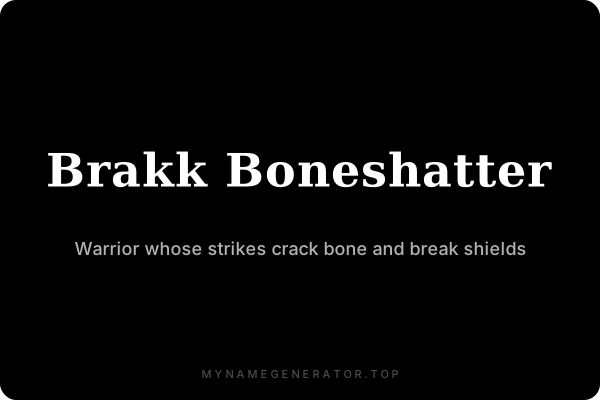
| Brakk Boneshatter | Warrior whose strikes crack bone and break shields | D&D | Male |
| Grakka Stormfist | Barbarian who charges like a storm-driven fist | D&D | Female |
| Durz of Westmarch | Half orc exile who made his name on human soil | D&D | Male |
| Morghara Ashbrand | Shaman marked by fire, carries the ash of her kin | Pathfinder | Female |
| Krolk Ironjaw | Paladin whose resolve is as unyielding as iron | D&D | Male |
| Vrazka of Highwall | Scout who slipped past every fortress wall | Eberron | Female |
| Thurag Coldspear | Warrior renowned for strikes that chill the blood | D&D | Male |
| Grenna Warhide | Berserker whose scarred hide has stopped a hundred blades | Pathfinder | Female |
| Makra | Diplomat who negotiates in two tongues with equal force | D&D | Female |
| Rorghul | Chieftain whose bloodline traces back to a full orc warlord | Eberron | Male |
| Skarruk Duskborn | Born at dusk, walks the line between two peoples | D&D | Neutral |
| Brugha of Ironford | Blacksmith-warrior who forged her own weapons and reputation | D&D | Female |
Featured Name Cards
Frequently Asked Questions
What are half orc names in D&D?
In D&D, half orc names blend orcish phonetics — hard consonants like K, G, R, and short vowels — with human naming traditions. A half orc might carry a pure orcish name like Morghul, a hybrid form like Durz of Westmarch, or an earned epithet like Boneshatter. The Player's Handbook lists names such as Dench, Feng, Gell, and Holg as typical examples.
What makes a good female half orc name?
Strong female half orc names keep the guttural force of orc roots while allowing slightly more variation in ending sounds. Names like Grakka, Morghara, Vrazka, and Brugha carry the same physical weight as male names. Adding an epithet — Stormfist, Ashbrand, Warhide — gives a female half orc character immediate presence at the table.
How do I create a half orc name with an orcish epithet?
Start with a two-syllable orcish root: Brak, Morg, Dur, Grak, Thur. Then add an epithet that reflects a battle deed, a physical trait, or an elemental force — Boneshatter, Coldspear, Ironjaw, Ashbrand. The compound reads immediately as a half orc warrior name. For a more human-inflected character, replace the epithet with a place suffix: Brakk of Westmarch, Durz of Ironford.
Are half orc names different from full orc names?
Yes, though they share phonetic roots. Full orc names — especially in Elder Scrolls Orsimer tradition — follow strict clan-suffix rules (gro-/gra-) and stay fully guttural. Half orc names in D&D are more flexible, often blending orcish roots with Common words, place names, or earned epithets that reflect the character's dual heritage and life among both orc and human societies.
Can half orcs have human names in D&D?
Absolutely. Half orcs raised among humans often adopt fully human names to fit in, while keeping an orcish nickname within their family or tribe. Conversely, half orcs raised in orc communities carry traditional orcish names without any human inflection. Many half orcs end up with both — a human name for diplomacy and an orcish name or epithet for combat.